The short answer: Chen Mingyuan was the pinnacle master of early-Qing Yixing, known as the 'Teapot Demon' (Hu Yao). His genuine survivals are exceedingly few, and his 'zisha in imitation of bronze ritual vessels' — the ding-form branch — is the rarest of all. This article uses a Kangxi Chen Mingyuan imitation-bronze ding-form beast-head ring-handled zisha teapot to explain its value logic through the master's stature, category scarcity and verifiable public results — with no discussion of attribution, only market and scarcity.
Who Chen Mingyuan was: the 'Teapot Demon', a founding master of Qing Yixing
Chen Mingyuan (style names Hefeng, Shixia Shanren, Hoyin) was a famous Yixing master of the Kangxi reign. He was not only the founding figure of the 'naturalistic' (huahuo) school, but also the first to inscribe poems and seals on teapot bodies, bringing a literati, bookish sensibility into zisha. As the saying went in his day, 'overseas, collectors compete for Mingyuan's dishes' — his contribution to Yixing history is immense.
What later generations revere most is his 'antiquity in clay' — using zisha to imitate bronze ritual vessels (ding, jue, gu, zun), 'equally skilled in modelling and carving, with an antique charm', transforming the solemnity of archaic bronzes into a scholar's desk toy, and sharply raising the artistic and cultural standing of Yixing ware.
Why 'bronze-form ding' is Chen Mingyuan's rarest branch
- The master's survivals are themselves extremely rare. Though famous in his day, genuine Chen Mingyuan pieces number only a handful, mostly in museums and top private collections, with very little on the open market.
- Bronze-imitation ritual wares are rarer than his naturalistic pieces. His pumpkin or 'Chuanxiang' teapots appear occasionally, but zisha modelled on bronze ding with beast-head ring handles is an order of magnitude scarcer — 'encountered by chance, never sought'.
- The technical bar is high. The ding form must balance three stable legs, model the three-dimensional beast-head ring handles, and imitate the bronze patina in clay tone — far harder to fire than a conventional teapot.
A concrete example: a Kangxi Chen Mingyuan imitation-bronze ding-form beast-head ring-handled zisha teapot
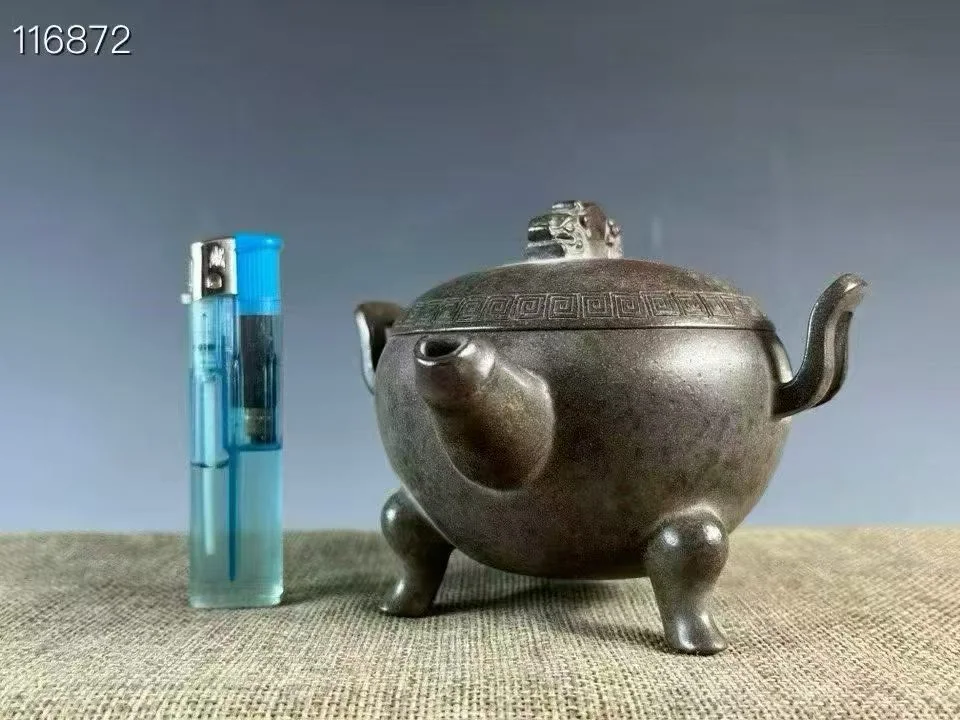
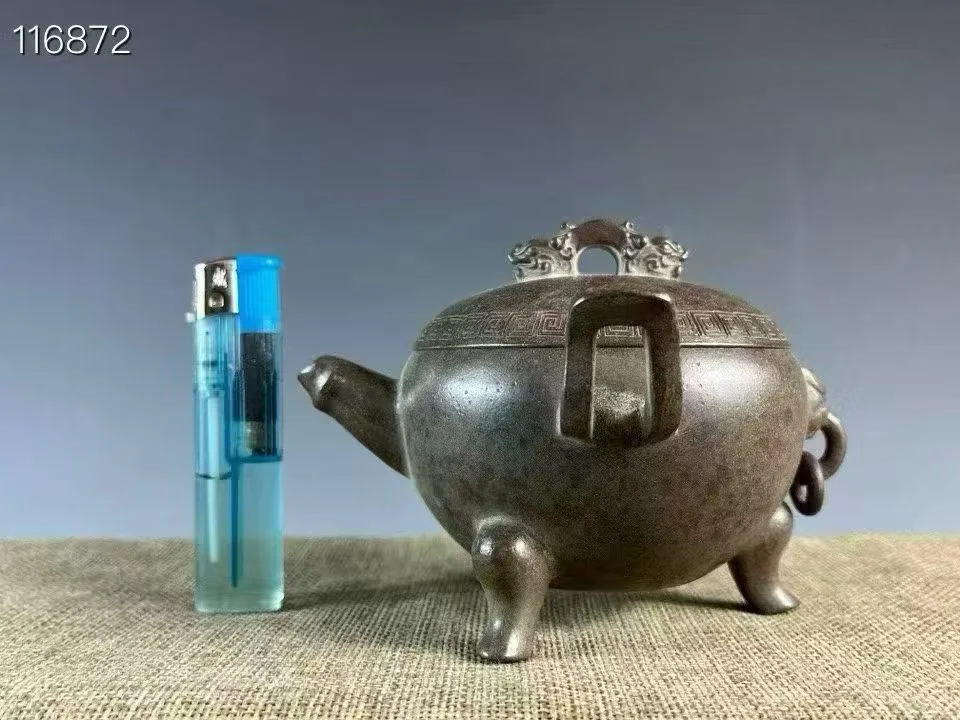
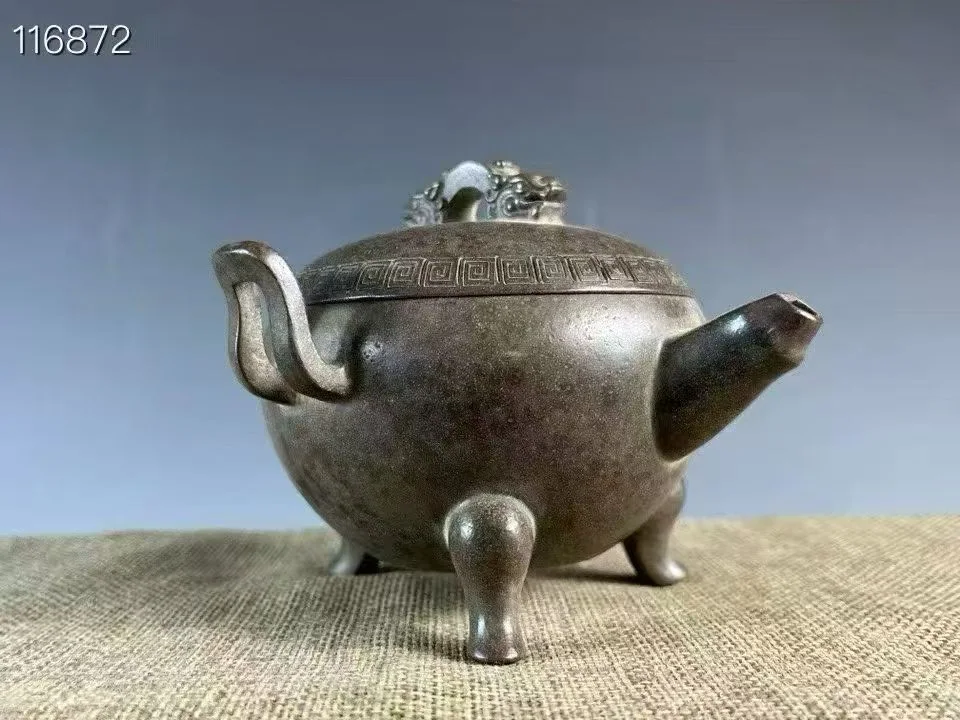
The following uses a submitted piece to illustrate the craft characteristics (describing only visible attributes, with no attribution judgement). The teapot takes the form of an archaic bronze ding: a rounded belly, three legs, a constricted mouth, a beast finial on the lid, and beast-head ring handles on the sides (beast heads biting movable rings), with a band of key-fret (leiwen) around the shoulder; the clay tone is deep like ancient bronze, heavy in hand. About 8.8 cm high and about 11 cm long (handle to spout), it is finely sized for a scholar's desk offering. Its form and ornament are in the same lineage as the standard surviving Chen Mingyuan 'bronze-imitation' wares.
The ding is the foremost of the bronze ritual vessels; a 'ding-form' zisha teapot condenses the gravity of Three-Dynasties bronzes into a piece that fits in the palm — the ultimate expression of Chen Mingyuan's 'antiquity in clay' aesthetic.
The value anchor: verifiable public Chen Mingyuan results
Chen Mingyuan prices have always been set by the public auction floor, not by word of mouth. The following are individually verifiable records (all in RMB, with approximate HKD in parentheses):
- 2016, Poly Huayi, 'Chuanxiang' teapot (square dou-form, four-legged) sold for RMB 34.50m (c. HKD 39m) — his personal auction record.
- 2016, China Guardian, pumpkin teapot sold for RMB 32.20m (c. HKD 36.5m).
- 2015, Beijing Poly, 'Sudai' teapot sold for RMB 31.625m (c. HKD 35.8m).
- 2022, Xiling, 'Dingmao' red-clay teapot sold for RMB 27.60m (c. HKD 31.3m).
- 2019, Xiling, 'Squirrel and Persimmon' teapot sold for RMB 26.22m (c. HKD 29.7m).
- 2023, Xiling, 'Wugou' teapot sold for RMB 21.6775m (c. HKD 24.6m).
- 2021, Shanghai Hosane, 'Qing Jue' (imitation-bronze wine vessel) sold for RMB 19.09m (c. HKD 21.6m) — showing his 'bronze-imitation' line also reaches the tens-of-millions tier.
- 2024, Scientia, hexagonal palace-lamp teapot RMB 11.50m; 2021, Guardian, large red-clay pumpkin teapot RMB 8.51m; 2019, Guardian, 'Chunxue' plum-petal teapot RMB 7.705m.
The common thread: all are named Chen Mingyuan masterpieces, and the square/archaistic/ritual-vessel pieces repeatedly sit at the top. They establish a clear fact — even his most common plain or naturalistic wares already repeatedly reach tens of millions of RMB at public auction; the 'bronze-form ding', his rarest category, naturally sits at the apex.
Why 'bronze-form ding' sits at the top
The scarcity premium is direct: the fewer comparables exist, the more fiercely each appearance is contested. Chen Mingyuan's 'bronze-imitation' ritual wares survive in extreme scarcity; when a fine piece with reliable provenance and outstanding clay tone and modelling appears, the price pushes upward. This is why reference estimates for such pieces are anchored to the top of the comparable-record range.
How such a piece reaches the market
If you hold a Chen Mingyuan zisha or comparable literati treasure, we suggest: first send multi-angle photos (full form, lid finial, beast-head rings, three legs, base mark) with dimensions; our specialists issue a written reference estimate range against public comparables; once aligned, we build a dedicated promotion page for global display. The promotion page for this Kangxi Chen Mingyuan imitation-bronze ding-form beast-head ring-handled zisha teapot is at the lot page; more works of art on the platform are on the works-of-art category page. The full path is in Consign and Process.
FAQ
- Who was Chen Mingyuan? A Kangxi-reign Yixing master, called the 'Teapot Demon', founder of the naturalistic school, the first to inscribe poems on teapots, and the pioneer who used zisha to imitate bronze ritual vessels, opening a new world of literati play.
- How scarce are Chen Mingyuan's 'bronze-imitation' works? His genuine survivals are already few, and the 'bronze-imitation' ritual wares (ding, jue, gu) are rarer than his naturalistic pieces by an order of magnitude, with very little in private hands.
- Where is the value anchor for Chen Mingyuan zisha? In public results: the 2016 'Chuanxiang' at RMB 34.50m, pumpkin at RMB 32.20m, 2015 'Sudai' at RMB 31.625m, and 2021 'Qing Jue' at RMB 19.09m; the 'bronze-form ding' is his rarest category.
- How do I consign such a piece? Send multi-angle photos with dimensions and weight; our specialists issue a written reference estimate range against public comparables, then we build a dedicated promotion page — see Consign.