The short answer: black-ground (moydi) falangcai was an enamel ground invented in the Kangxi reign and is the rarest class of imperial falangcai. Survivals are counted in single digits and almost all sit in museums. That rarity is exactly why comparable imperial falangcai bowls have reached hundreds of millions of HK dollars at auction — this article sets aside questions of attribution and simply lays out the scarcity, the imperial mark and the verifiable results.
What black-ground falangcai is: a black enamel ground invented under Kangxi
Falangcai (literally 'porcelain-body painted enamel') is the most aristocratic and least produced of all Chinese porcelain: the finest plain bodies were selected at the Jingdezhen imperial kilns, sent to the Palace Workshops inside the Forbidden City, enamelled by court painters, then fired a second time in a low-temperature kiln. Where the ground is black enamel, it is called 'black-ground falangcai'. Research from the National Palace Museum in Taipei notes that black-ground painted enamels were a creation of the Kangxi reign — a ground experiment unique to that emperor and rarely seen afterwards.
Firing an even, lacquer-black ground on porcelain is exceptionally hard: the black tone is unstable, prone to greying or streaking, and only a handful fired to a true mirror black. Black-ground porcelain falangcai therefore survives in far smaller numbers than the common white-, yellow- or rouge-ground wares, sitting at the very tip of the pyramid.
Why it is scarce: three irreversible constraints
- Minuscule output. Across the Kangxi, Yongzheng and Qianlong reigns, imperial falangcai porcelain totals only about 400 pieces, over 90% of which are in the Taipei and Beijing Palace Museums; black-ground examples are a fraction of that fraction.
- Hard to fire. The black ground required plain bodies shipped to Jingdezhen, enamelled in the capital, then fired a second time at low temperature — a two-city, three-firing process; the black tone was the hardest to stabilise, so the yield was tiny.
- Court monopoly. Except for a few pieces awarded to Mongol princes or the Dalai Lama, falangcai was reserved for the court throughout the Qing and was never made for the public, leaving almost nothing to circulate.
A concrete example: a black-ground falangcai bowl with peony, chrysanthemum and lily
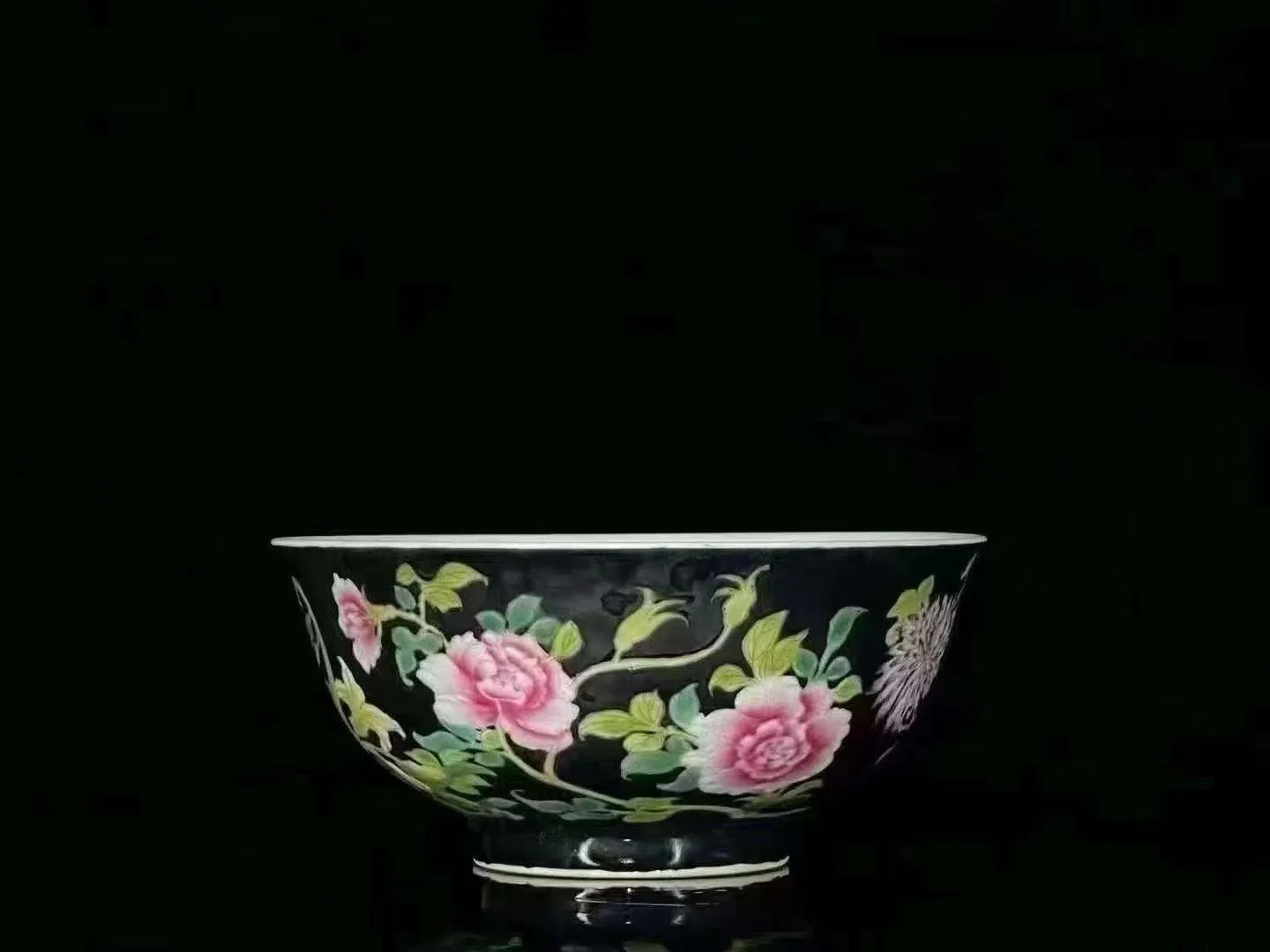
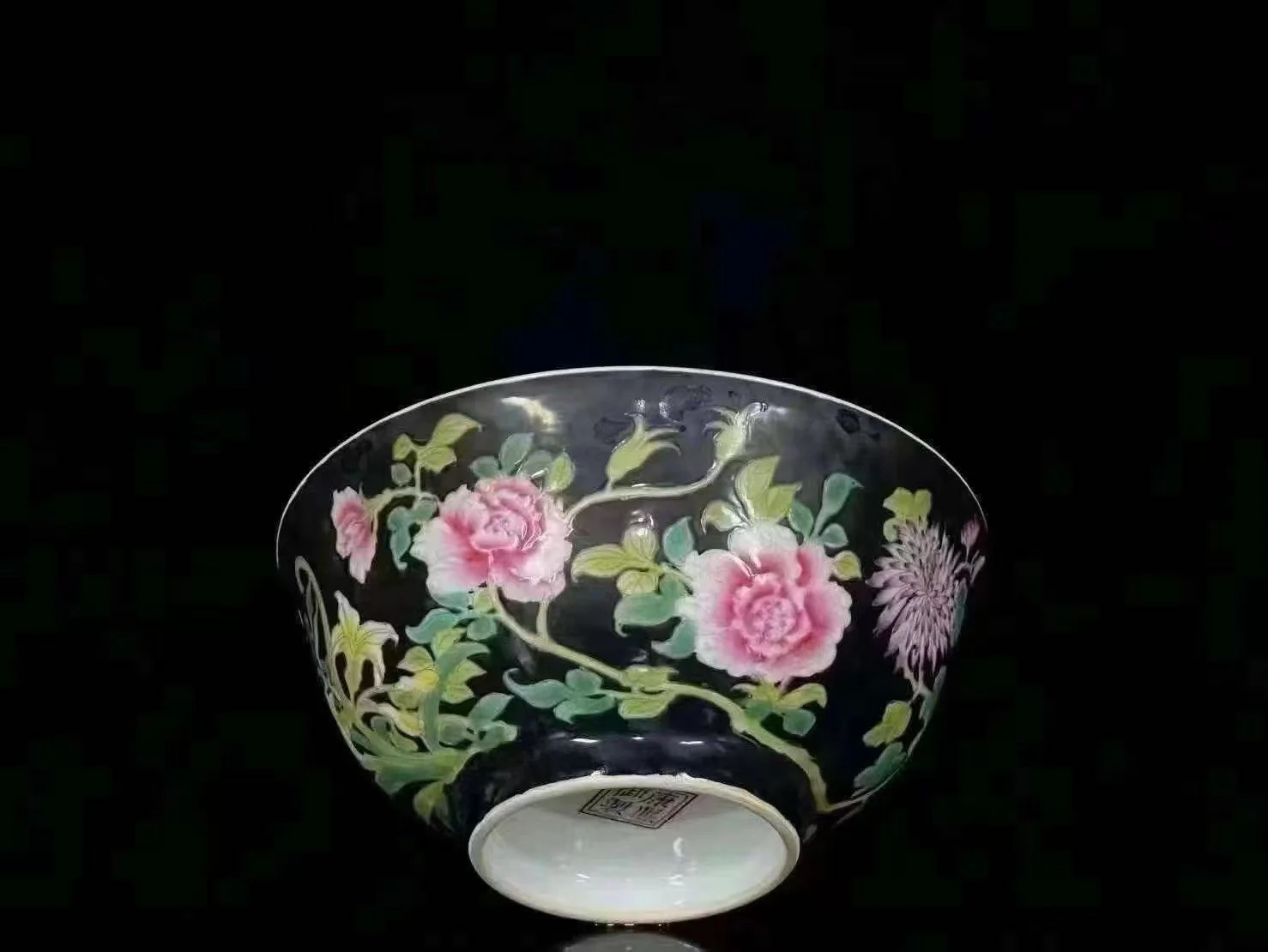
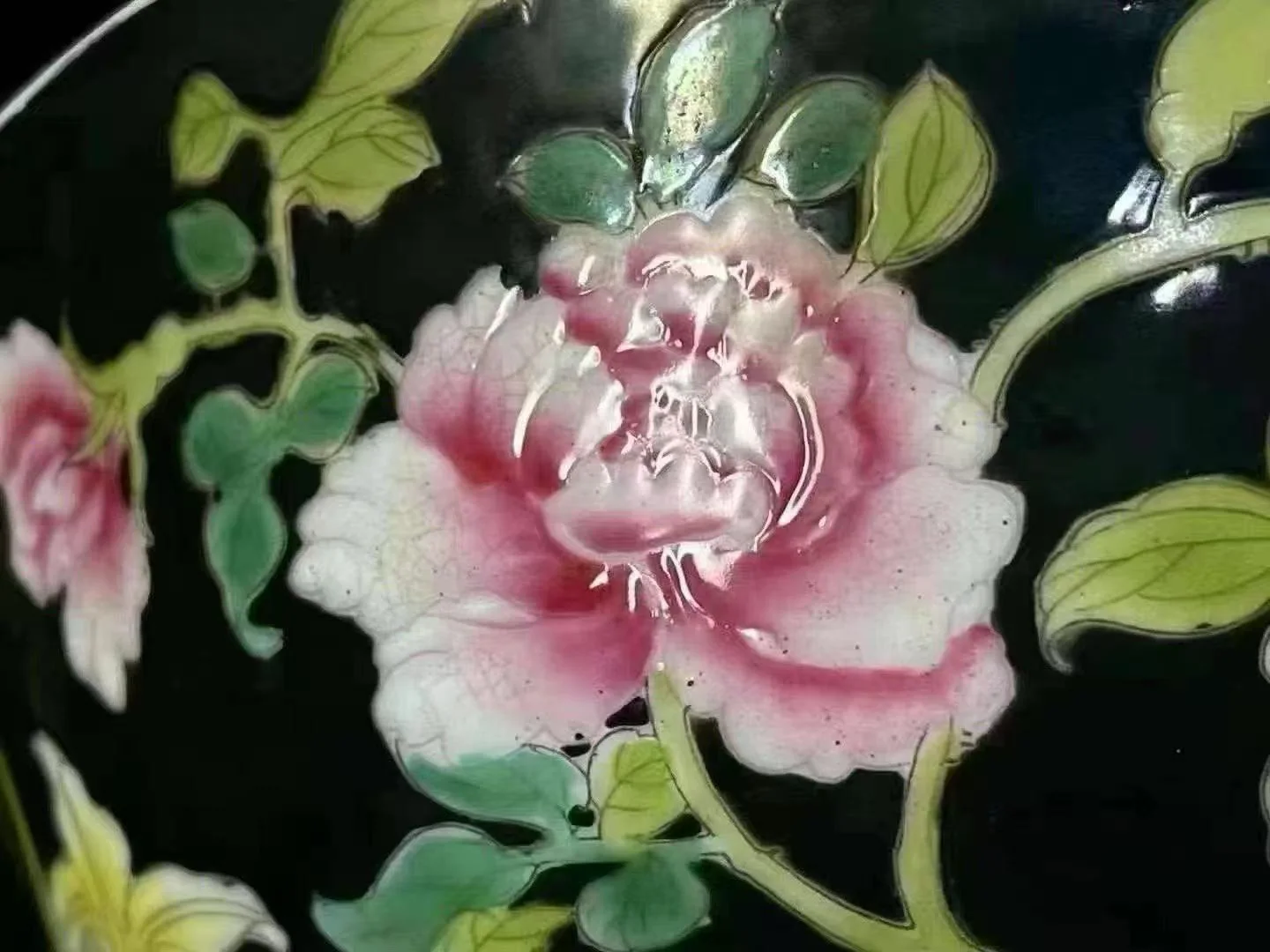
The following uses a submitted piece to illustrate the craft characteristics of such an object (describing only visible attributes, with no attribution judgement). The bowl is 15.7 cm in diameter and 7 cm high, with a rounded deep body and a foot ring. The exterior is covered in a lacquer-black ground, on which falangcai enamels paint three flower groups — peony, chrysanthemum and lily — with layered pink petals and green leaves that stand slightly proud of the surface; a fine white line runs along the rim. The interior is left plain white. At the centre of the foot, an iron-red 'Kangxi yuzhi' four-character double-line square seal mark is written — the standard mark form of Kangxi imperial falangcai.
Set beside the Kangxi black-ground (copper-body) painted-enamel flower box in the Taipei Palace Museum collection, the same lineage appears: red flowers and green leaves on a black ground, peonies and chrysanthemums together, and the iron-red 'Kangxi yuzhi' square seal — black-ground painting was a consistent Kangxi court vocabulary.
The value anchor: verifiable eight-figure results
Falangcai prices rest on public sales, not hearsay. Three recent records for Kangxi imperial falangcai bowls form a clear value ladder:
- 2018, Sotheby's Hong Kong: a Kangxi imperial falangcai bowl (rouge-pink ground, 'flowers in panels', 14.7 cm, from the Henry Knight collection) sold for HK$238.8 million (238,807,500), a world record for a bowl-form porcelain.
- 2019, Christie's Hong Kong: a Kangxi imperial falangcai 'double lotus' bowl (white ground) sold for HK$87.2 million.
- 2002, Sotheby's Hong Kong: a Kangxi falangcai bowl (rouge-ground, 14.2 cm) sold for HK$7 million.
The common thread of all three records is exactly the three scarcity variables above: the imperial mark, the tiny output, and a clear provenance. Black ground is rarer than pink or white ground — invented under Kangxi and hardest to fire — so on the value ladder of imperial falangcai bowls, black ground sits at the top. Our reference estimate for such pieces is anchored to this verifiable set of records.
Why black ground sits at the top
The scarcity premium is simple: the fewer comparables exist, the more fiercely each appearance is contested. White- and pink-ground falangcai still surface at auction in a handful of examples; black-ground falangcai is seen almost only in museum collections and the occasional private deaccession. When there is effectively no second example to buy, the price anchor rises above the comparable-record level — which is why top imperial falangcai bowls are estimated in hundreds of millions of HK dollars.
How such a piece reaches the market
If you hold a black-ground or comparable imperial falangcai piece, we suggest this order: first send multi-angle photos (rim, exterior, foot mark, base) with dimensions and weight; our specialists issue a written reference estimate range against public comparables; once aligned, we build a dedicated promotion page for global display. The promotion page for this black-ground falangcai bowl is at the lot page; more porcelain on the platform is on the porcelain category page. The full path is in Consign and Process.
FAQ
- How does black-ground falangcai differ from ordinary falangcai? Black (moydi) ground uses a black enamel ground and was invented under Kangxi; its tone is the hardest to fire, so it is the rarest — the tip of the imperial falangcai pyramid.
- How many Kangxi imperial falangcai survive? Across the three early-Qing reigns, imperial falangcai porcelain totals about 400 pieces, over 90% in the Taipei and Beijing Palace Museums, with very little in private hands.
- Where is the value anchor for a black-ground falangcai bowl? In public results for comparable imperial falangcai bowls: the 2018 pink-ground bowl at HK$238.8m and the 2019 white-ground bowl at HK$87.2m; black ground is rarer and sits at the top.
- How do I consign such a piece? Send multi-angle photos with dimensions; we issue a written reference estimate range; once aligned we build a dedicated promotion page — see Consign.