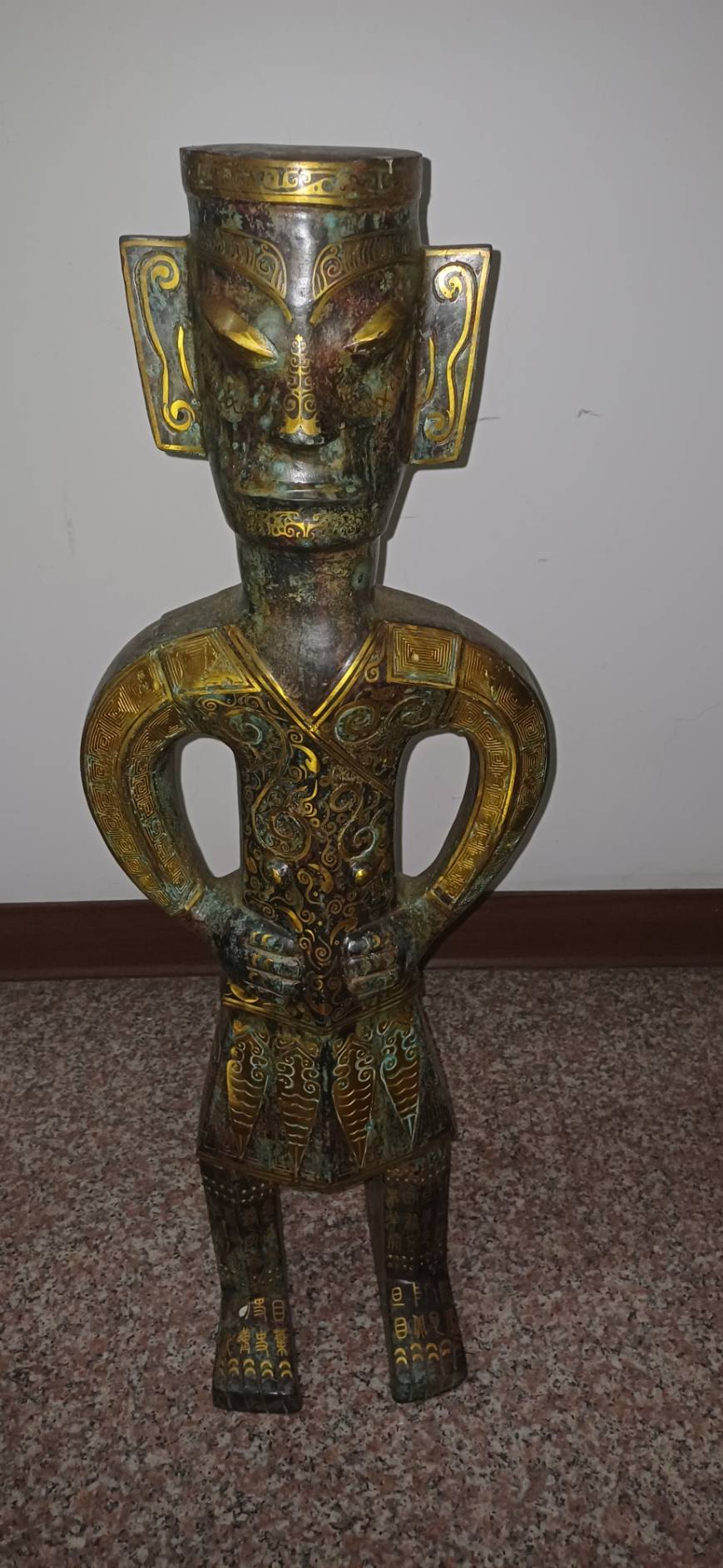
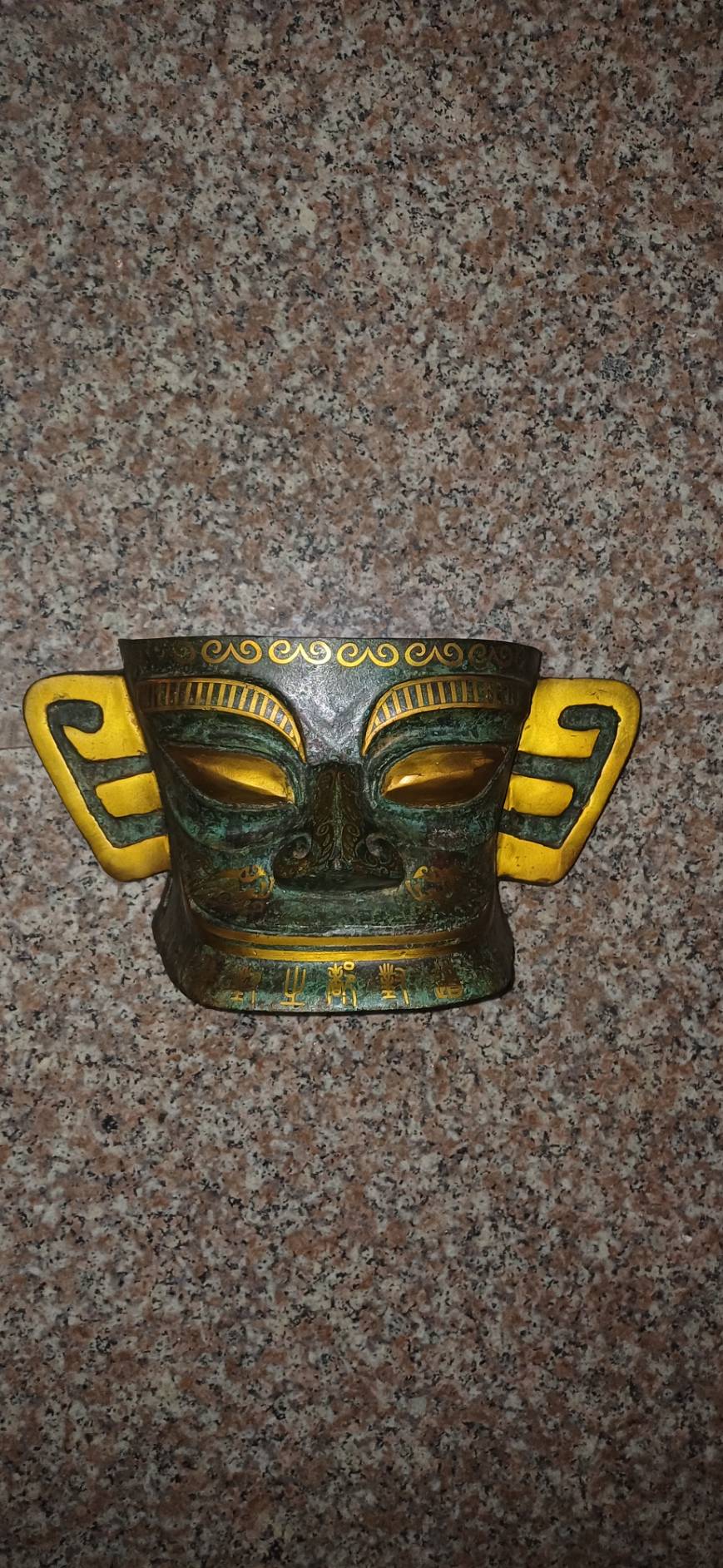
Late last month, an elderly collector sent us photos of a group of bronzes: a standing figure with a cylindrical crown, flared ears and hands resting on the abdomen, together with two wide-eared masks, the surfaces covered in malachite-green patina and bright gilded ornament. His opening line: “Someone told me this is from Sanxingdui.”
As a desk that handles submissions year-round, we know this opening well. Since the new Sanxingdui Museum opened on 27 July 2023, interest has only grown — and so has the supply of Sanxingdui-style bronzes on the market. So rather than discussing one object, this article uses the actual pieces in front of us to set out five things clearly: the archaeology, the legal boundaries, what style-cast pieces really are, how to authenticate, and the right way to sell.
What Sanxingdui Is: From the Yan Family Courtyard to Eight Sacrificial Pits
The Sanxingdui site in Guanghan, Sichuan covers about 12 square kilometres and spans roughly 4500 to 3000 years before present, its core period corresponding to the late Xia through Shang and Zhou. A farmer discovered a cache of jades at the Yan family courtyard in the late 1920s; in 1934 curators of the West China Union University Museum led the first formal excavation. The world-shaking moment came in July–September 1986, when Pits 1 and 2 yielded 1,720 objects including the gold staff, the bronze sacred tree, the standing figure and the protruding-eyed mask. The Sanxingdui culture was formally named in 1987, and in 1988 the site became a National Key Cultural Relics Protection Unit. In 2019 six more pits were found; in September 2021 a complete gold mask from Pit 3, about 40 cm wide and 27 cm high unfolded, was announced. Landmark dimensions: the standing figure 2.62 m tall and about 180 kg; the protruding-eye mask 138 cm wide and 66 cm tall; the No.1 tree 3.96 m; the gold staff 1.42 m and about 500 g. The new museum, opened 27 July 2023, displays over 1,500 objects across 22,000 square metres.
Two keywords matter for what follows: sacrificial pits, and state-led archaeology.
Why a Genuine Sanxingdui Piece Is Essentially Impossible in Private Hands
Under China’s Law on the Protection of Cultural Relics, all artifacts excavated within the country belong to the State. Every object from the Sanxingdui pits — 1,720 from the 1986 season and nearly 2,000 more from the six new pits — is held within the archaeological institutional system, and the site itself has been protected since 1988, with severe criminal liability for looting and trafficking. A “freshly dug” Sanxingdui piece fails on both the legal and the archaeological level. In my view this is the first thing to tell any consignor: not to pour cold water, but to save them the cost of pursuing a possibility that does not exist.
So What Circulates? Three Identities of the Style Cast
We group them as: (1) full-size craft reproductions for exhibition and teaching; (2) decorative art objects that borrow Sanxingdui’s visual language; (3) mass-produced imitation antiques most often packaged as excavated treasures. Each tier has its own price logic. The problem is never the reproduction itself — a fine reproduction displayed as décor is perfectly legitimate. The problem is pricing a commodity with a “national treasure” narrative.
Reading the Pieces: A Craft Profile
Four observations on this group. First, the gilding: Sanxingdui’s gold was hammered into extremely thin skins applied to the bronze, typically found fragmented on excavation; here the gold is uniform, sharp-edged and complete, the signature of modern gilding. Second — decisive — the inscriptions: gold characters appear across the skirt, shins, feet and the masks’ ears (Figs. 3–4). Published Sanxingdui bronzes carry no extended inscriptions; Shang-Zhou epigraphic convention places inscriptions cast or engraved on inner walls and bases, never displayed across the body like a stone stele. Third, the patina: the green is evenly distributed with uniform layering and clean gold–patina boundaries — a short-cycle artificial patina. Fourth, the masks’ ears are near-perfectly symmetrical, as if from one mould; hand-finished ancient bronzes rarely are.
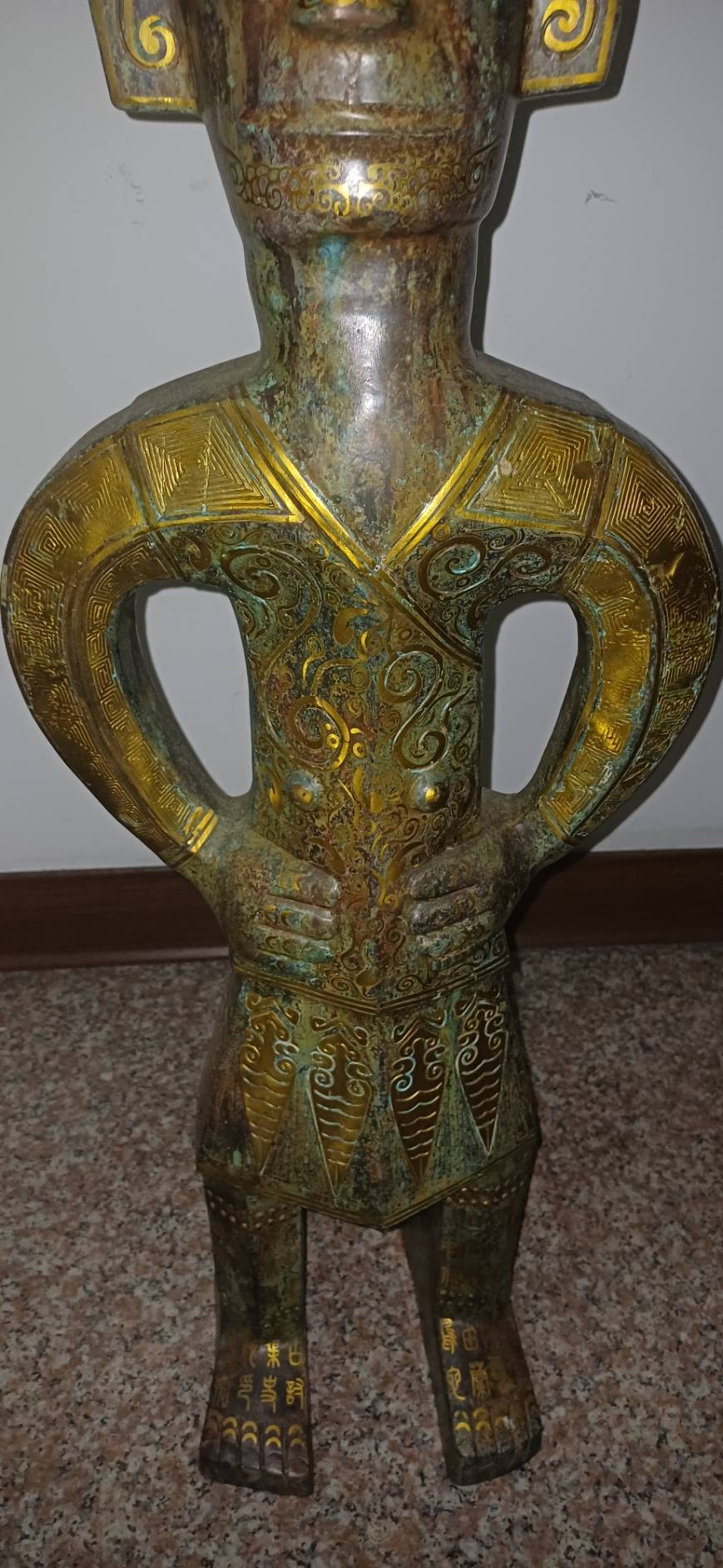
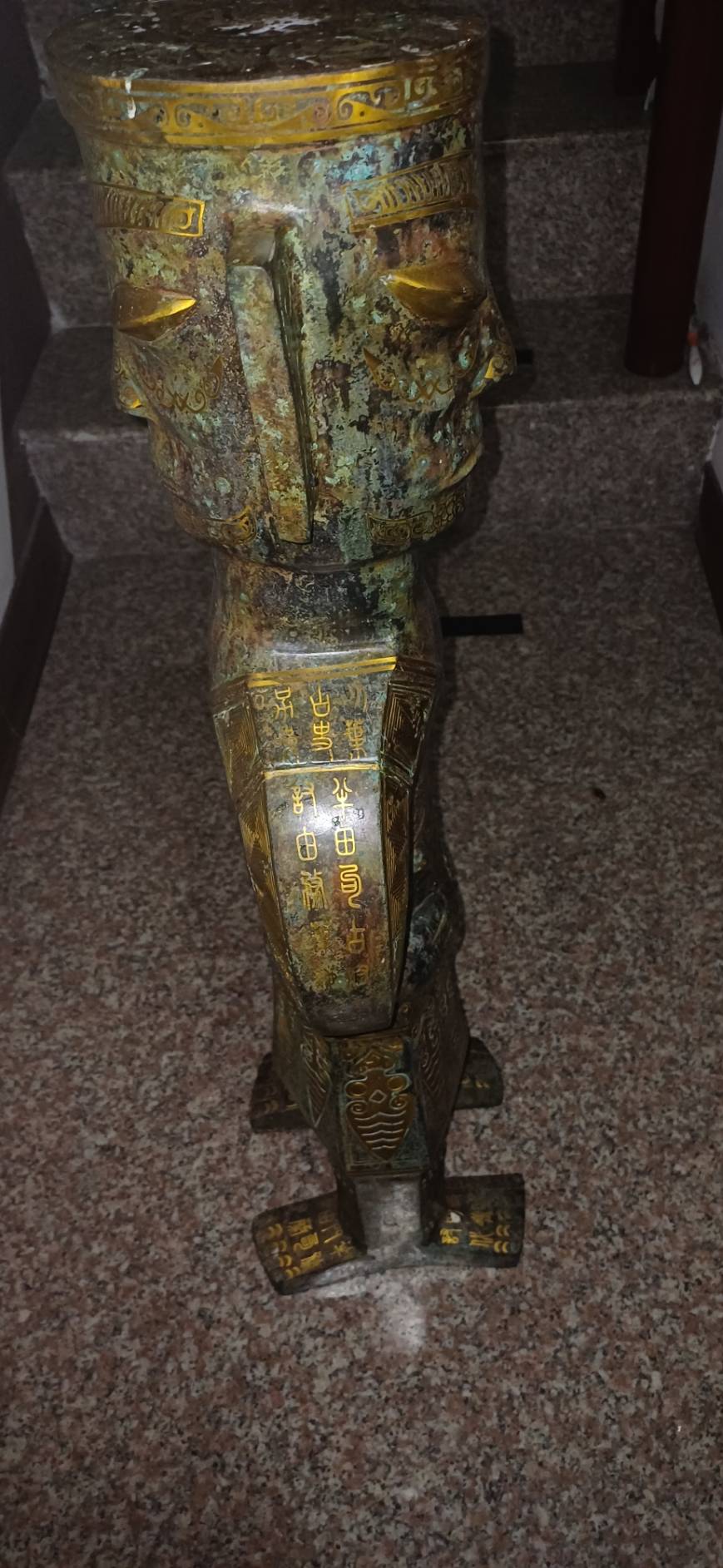
Conclusion: a carefully made Sanxingdui-style recast, respectable craftsmanship, a decorative art object — not an antiquity. That is exactly what our written opinion said, and how we graded it.
Five Steps of Bronze Authentication
Patina: real patina grows in layers, crystallises, and interlocks with the metal body. Casting: seam lines, chaplets, gates and repairs signal traditional methods; overly clean one-piece modern casting is itself a dating signal. Metal: fracture colour and impurity distribution differ by era. Inscriptions: character edges, script style, placement conventions — full-surface gold inscriptions fit no period convention. Weight and sound: auxiliary only. Every single check can be faked; all five must corroborate, and final conclusions require hands-on inspection and instrument testing.
The Real Market: Three Verifiable Sales
The Western Zhou Xijia basin, the only surviving piece from the Southern Song imperial collection, with 133-character inscription and 35 historical publications, sold at Xiling Yinshe’s spring auction on 15 July 2017 for RMB 212.75 million including premium — then a record for Chinese works of art at auction. In March 2017, the Shang-Zhou fangzun and fanglei from the Fujita Museum sold at Christie’s New York for over RMB 200 million each. Xiling’s ritual-bronze sales have run at near-total sell-through since 2014. The common thread is provenance and publication — the market pays for documented history, not for shape.
How to Sell: Path and Checklist
Send six or more clear photos (front, back, sides, top, base, close-ups of ornament and any inscription) plus measurements and weight; receive a written appraisal with a three-tier price range; once aligned, the platform builds a dedicated promotion page — see our process and selling guide. For provenance pieces, gather old photos, receipts, exhibition records and publications. Fee and settlement terms are set out in writing before signing.
FAQ
- Can a private collector obtain a genuine excavated Sanxingdui piece? Practically no — excavated artifacts belong to the State; tradable bronzes are limited to transmitted, provenance-documented pieces.
- Do Sanxingdui-style bronzes have value? In tiers: reproductions, teaching models and decorative objects each have their own market based on craft and display function, not archaeological value.
- How to preliminarily judge a bronze? Five checks — patina, casting marks, metal body, inscriptions, weight and sound — must all corroborate; final conclusions require hands-on inspection.
- How to sell through the platform? Send 6+ photos with measurements and weight; receive a written appraisal; fee and settlement terms in writing. See our consignment page.
Sanxingdui’s greatness lies in public memory — the awe belongs to everyone standing before those faces. Private collecting can understand the forms, admire the craft, and stay alert to narratives built on them. Give “style” back to the style casts, and give “provenance” back to genuine works of history. That is what we most want to say to every consignor at the submission desk.