The short answer: Kangxi copper-red (jihong) glazed bowls are among the hardest-fired and scarcest of all Qing monochrome wares. Copper-red glaze is notoriously sensitive to kiln temperature and reducing atmosphere — the trade saying 'one treasure per thousand kilns' comes from exactly this — so fine survivals are few and every appearance on the market is contested. This article sets aside questions of attribution and simply lays out the firing difficulty, the scarcity and the verifiable public results.
What jihong is: a Kangxi milestone in reviving high-fire copper-red
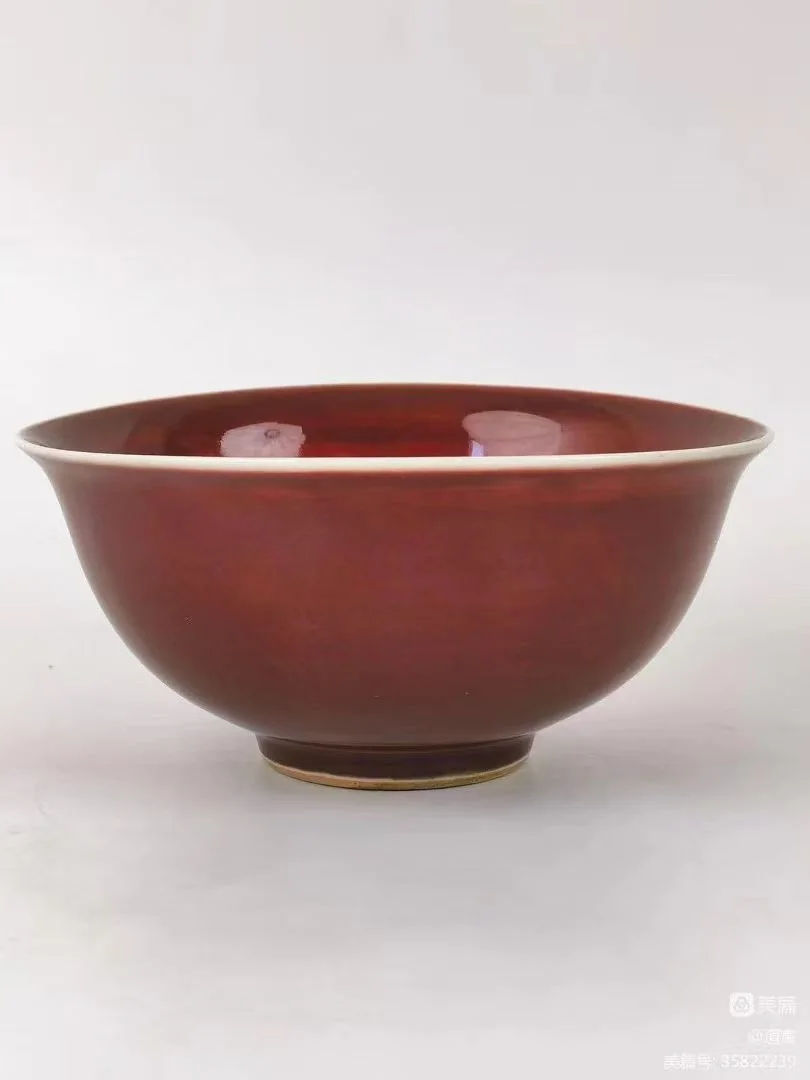
Jihong (also written 'jihong') is a high-fired reduction copper-red glaze of the Qing imperial kilns. The Kangxi reign revived and standardised it on the basis of imitating Xuande's 'precious red', making it a classic of later imperial monochrome wares. Its hallmarks: an even red glaze overall, a naturally formed white line at the rim (the 'rush-white' edge), an unglazed foot ring, and an underglaze-blue reign mark on the base.
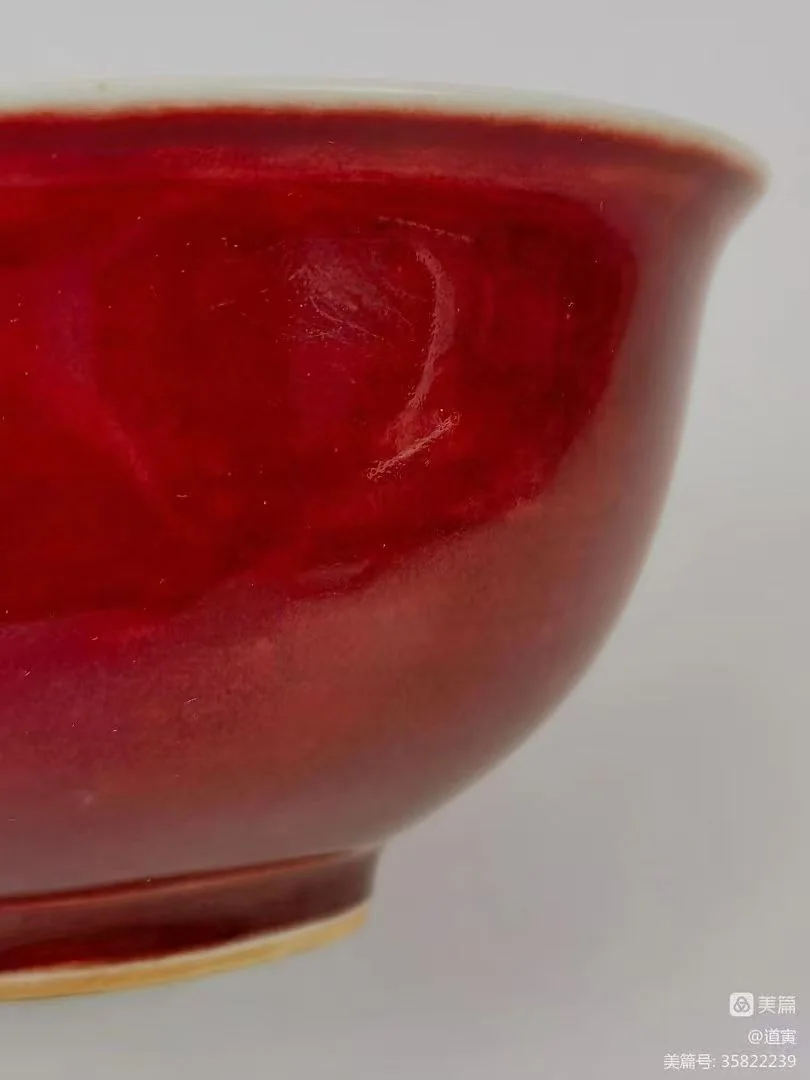
The beauty of the glaze lies in the balance between depth and brilliance — too much firing and it turns purplish, too little and it greys; only a few pieces achieve a uniform gem-like red. This extreme dependence on firing control is precisely the root of its scarcity and value.
Why it is scarce: three natural thresholds of copper-red
- Exceptionally hard to fire. Copper-red requires precise control of temperature in a reducing atmosphere; the slightest deviation in kiln conditions ruins the piece. The trade saying 'one treasure per thousand kilns' reflects a very low yield.
- Unstable colour. Glaze thickness, flow and pooling all affect the final tone; few pieces achieve an even gem-red, and most show tonal variation and running glaze.
- Court positioning. Jihong was an imperial ritual and connoisseur's ware, not a popular glaze; pieces with a reign mark are mostly from the imperial kilns, and fine examples in private hands are limited.
A concrete example: a Kangxi jihong glazed bowl
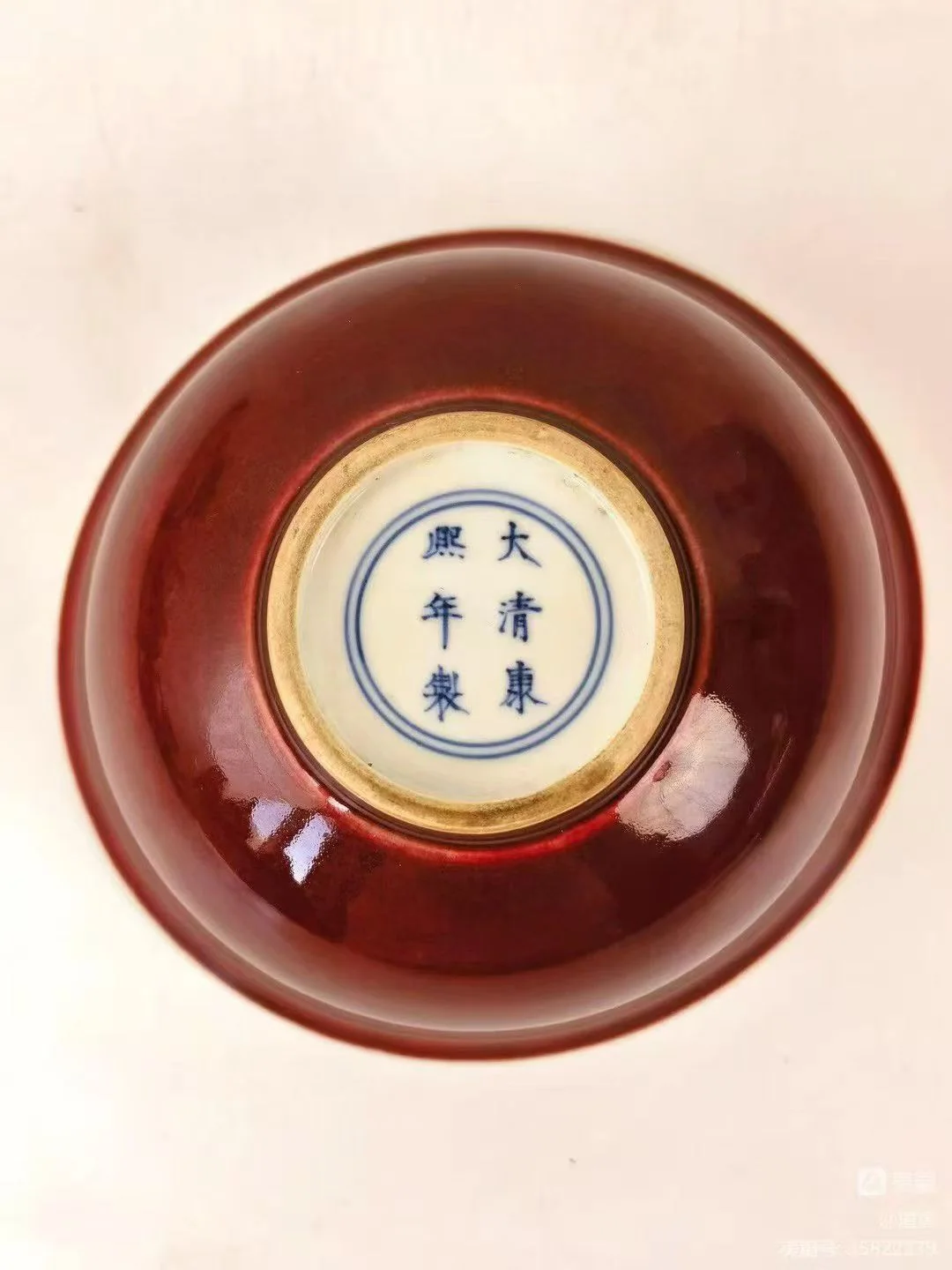
The following uses a submitted piece to illustrate the craft characteristics (describing only visible attributes, with no attribution judgement). The bowl has a rounded deep body and a foot ring, is covered overall in copper-red glaze, and retains a fine white line at the rim (the rush-white edge); the foot is unglazed, the base is white-glazed, and a six-character 'Da Qing Kangxi Nian Zhi' reign mark in underglaze blue within a double circle is written on the base — the standard mark form for Kangxi imperial jihong bowls.
This combination — red inside and out, a rush-white rim, and a double-circle six-character reign mark on the base — is the typical lineage of Kangxi jihong bowls, in the same tradition as comparable pieces in the Palace Museum and important private collections.
The value anchor: verifiable public results
Monochrome prices, too, rest on public sales rather than word of mouth. Several verifiable records for Kangxi copper-red bowls form a clear reference:
- 2014, Christie's Hong Kong: a Kangxi copper-red glazed bowl (underglaze-blue double-circle six-character mark, 15.5 cm) estimated HKD 300,000–500,000, sold for HKD 750,000.
- Christie's: a pair of Kangxi copper-red glazed bowls (double-circle six-character mark, 15.5 cm) sold for USD 182,500 (the pair; roughly HKD 710,000 each).
- 2012, Sotheby's Hong Kong: a Kangxi 'peachbloom'-style bowl (double-circle six-character mark) sold for HKD 800,000.
- 2023, China Guardian: a Kangxi jihong bowl from the Tianminlou collection sold for RMB 460,000.
The common thread: all are Kangxi-period, with standard reign marks and stable red tones. Together they establish a clear fact — a well-preserved Kangxi jihong bowl with a settled red glaze already sits firmly in the hundreds-of-thousands-to-low-millions HKD range on the open market, with a clear premium for provenance.
Why fine examples sit at the top
The scarcity premium is direct: the fewer comparables exist, the more fiercely each appearance is contested. Kangxi jihong bowls are not unique, but those with a standard six-character mark, an even red, and complete condition remain consistently scarce in the market; when a fine example with reliable provenance and outstanding colour appears, the price pushes upward. This is why reference estimates for such pieces are anchored to the top of the comparable-record range.
How such a piece reaches the market
If you hold a Kangxi jihong or comparable monochrome piece, we suggest: first send multi-angle photos (the rush-white rim, the exterior glaze, the foot mark, the base) with dimensions; our specialists issue a written reference estimate range against public comparables; once aligned, we build a dedicated promotion page for global display. The promotion page for this Kangxi jihong bowl is at the lot page; more porcelain on the platform is on the porcelain category page. The full path is in Consign and Process.
FAQ
- How do jihong and 'jihong' (祭紅) differ? Jihong is also written 祭紅; the two are the same glaze under different characters, both referring to the high-fired copper-red glaze revived under Kangxi, marked by a white rim and a reign mark on the base.
- Why is a Kangxi jihong bowl so hard to fire? Copper-red glaze is extremely sensitive to kiln temperature and reducing atmosphere, with a very low yield — the trade saying is 'one treasure per thousand kilns' — so fine survivals are scarce.
- Where is the value anchor for a Kangxi jihong bowl? In public results: the 2014 Christie's copper-red bowl at HKD 750,000 and the Sotheby's peachbloom-style bowl at HKD 800,000; pieces with a settled red and clear provenance reach the million-HKD range.
- How do I consign such a piece? Send multi-angle photos with dimensions; we issue a written reference estimate range; once aligned we build a dedicated promotion page — see Consign.
Related reading · more from this series
- Why Falangcai Is So Expensive: Black, Pink and White Grounds Compared — scarcity ranking and records in one read.
- Kangxi black-ground falangcai bowl (on platform) — another black-ground piece currently listed.
- The value logic of a Kangxi black-ground falangcai — scarcity and records for the single piece.